We may earn a commission from purchases through links in this article, at no extra cost to you. How we earn
Choosing a bit by material alone is not enough. The cutter’s shape and flute count matter, but so do the tool diameter, the machine’s limits, and the cutting conditions you can actually support. A listing title may name a material; it does not establish a safe feed rate, cutting depth, or compatibility with your spindle.
This guide compares three listing-described options: a four-flute HSS end mill set, a two-flute compression cutter for woodworking, and a spoilboard surfacing bit. The assessment is based on supplied listing information, not physical testing. Feeds and speeds are not specified for any of them.
Start with the job, then set feeds and speeds
Feeds and speeds are not a fixed property of a bit. They depend on the cutter, material, machine rigidity, spindle, and toolpath. None of the supplied listings provides a recommended spindle speed, feed rate, or depth per pass, so there is no evidence-based setting to copy from this comparison.
- Match the cutter to the operation. Decide whether you need a general end mill, a woodworking compression cutter, or a surfacing tool. These options are listed for different jobs.
- Check the actual listing details. Confirm the selected diameter, shank, flute geometry, material guidance, and any manufacturer-provided cutting data. A range in a title does not confirm which size is included in a particular listing variation.
- Check the machine and workholding. Verify that the spindle or collet accepts the shank and that the machine and stock can support the intended cut. The supplied product data does not establish compatibility with a specific router.
- Use applicable cutter and machine guidance to choose settings. Do not treat an unknown feed, speed, or pass depth as an endorsement. Reassess when changing tool diameter, material, or setup.
For a general end mill: four-flute HSS set
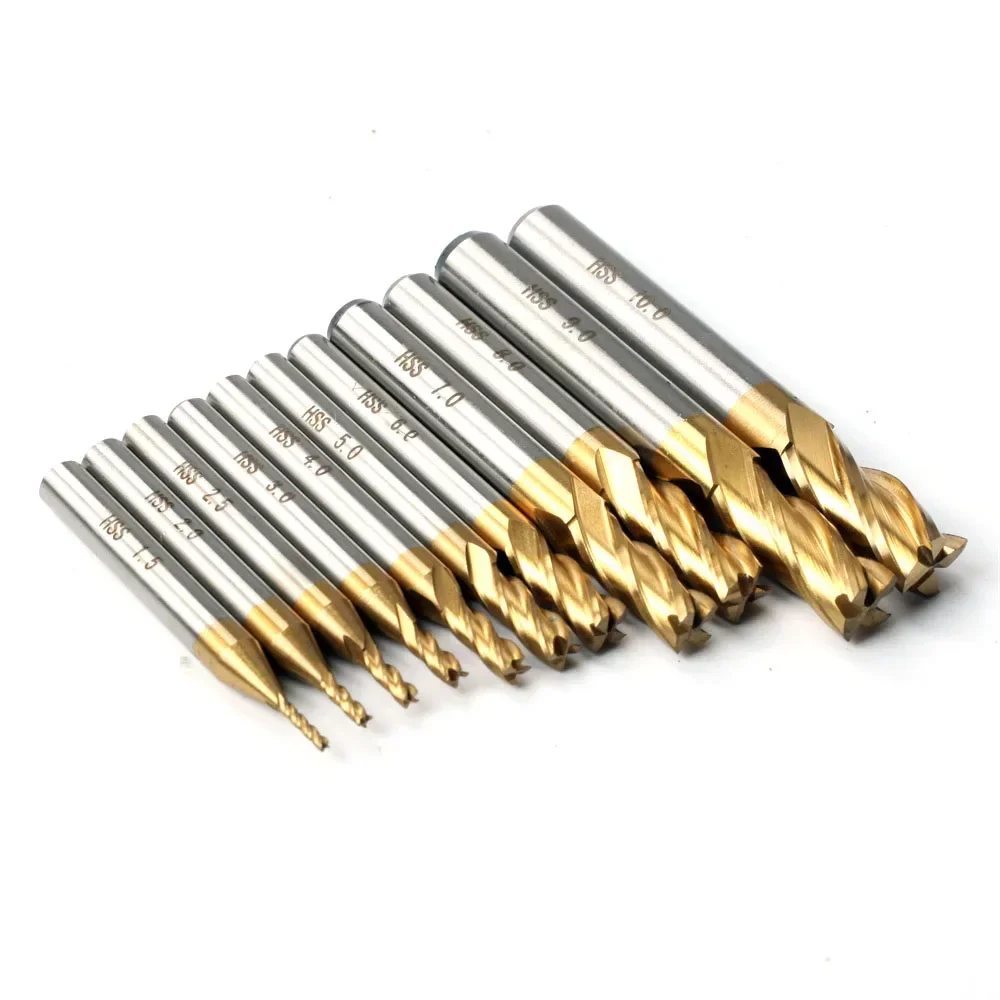
The primary candidate is listed as a titanium-coated, four-flute HSS end mill set for wood and steel milling, with title-listed diameters from 1.5 to 10 mm and one-, seven-, or eleven-piece options. It has the broadest material claim among these candidates, but the title alone cannot establish that a particular size or configuration suits your machine or job.
Consider it if you want to compare a general-purpose set and can verify the chosen variation, shank dimensions, and suitability for your specific material and machine. Its trade-off is uncertainty: no cutting data, detailed material guidance, or compatibility information is supplied here. The title’s reference to steel milling should not be read as confirmation that every desktop CNC router can mill steel with this cutter.
The listed reference price is $4.49 USD and may change.
For woodworking: two-flute compression cutter
This supporting option is titled as a two-flute spiral carbide compression cutter for woodworking, with up-cut and down-cut wording in its listing. That makes it the most specifically woodworking-focused candidate in this set. The supplied facts do not give its diameter, shank size, cutting data, or the exact geometry of each available variation.
It may suit a woodworker comparing a dedicated compression-style cutter rather than a general HSS end mill. Before choosing it, confirm the configuration and dimensions in the listing and check whether the cutter’s intended use matches your stock, machine, and toolpath. Do not assume a particular edge finish or cutting result from the title alone.
The listed reference price is $3.80 USD and may change.

For surfacing: spoilboard flattening bit
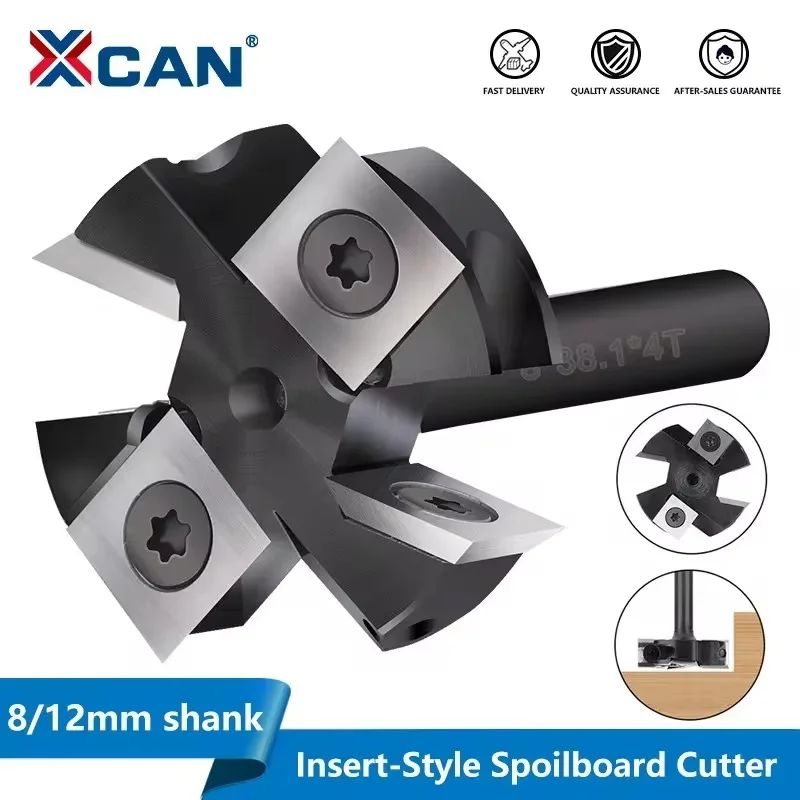
The other supporting candidate is listed as an XCAN CNC spoilboard surfacing bit for slab flattening and wood planing, with 8 mm or 12 mm shank options and carbide inserts. Its listed role is different from the two end mills: it is the relevant option to investigate when the job is flattening a spoilboard, not general-purpose cutting.
Check which shank option is selected and whether it fits your machine’s collet. The supplied listing facts do not provide the cutter’s diameter, cutting width, recommended speed, feed, or pass depth, so confirm those details before planning a surfacing operation. A surfacing bit is not a substitute for an end mill when the task calls for one.
The listed reference price is $25.79 USD and may change.
Quick choice by operation
| Your job | Candidate to investigate | Confirm before buying |
|---|---|---|
| General milling where the listing’s wood and steel claim is relevant | Four-flute HSS end mill set | Selected diameter and set, shank, machine suitability, and cutting guidance |
| Woodworking with a compression-style cutter | Two-flute spiral carbide compression cutter | Exact geometry, diameter, shank, and suitable cutting conditions |
| Spoilboard surfacing or wood flattening | Carbide-insert surfacing bit | Selected 8 mm or 12 mm shank, cutter dimensions, and recommended settings |
Recommendation: buy for the operation you can verify
For a general end mill set, start with the four-flute HSS candidate, but verify the selected configuration and machine suitability rather than relying on its broad title. For woodworking where a compression cutter is specifically desired, compare the two-flute option and confirm its missing dimensions. For spoilboard flattening, the surfacing bit is the job-specific choice to investigate; its listed shank options make collet compatibility an essential check.
No candidate comes with supplied feeds, speeds, or depth-per-pass guidance. Treat those as unresolved purchase questions, not values to guess from the product title.