We may earn a commission from purchases through links in this article, at no extra cost to you. How we earn
Retrofitting a desktop CNC router with a 450nm blue diode laser module expands a standard three-axis rotary mill into an engraving and light cutting platform. However, translating marketplace listings into a functioning physical toolpath requires careful attention to electrical and mechanical interfaces. Diode modules depend on specific signal voltages, separate DC power feeds, and precise focal distances that standard spindle brackets were never built to accommodate.
This evaluation guide compares open-market listings and manufacturer-supplied specifications to assess hardware compatibility, optical parameters, and wiring requirements. No hands-on testing was performed on these components; instead, all assessments are grounded in documented technical standards, published seller specifications, and physical mounting interfaces to clarify what these upgrades deliver—and where manual adaptation remains necessary.
Electrical Integration: PWM Logic and Power Overhead
Most desktop CNC motherboards—such as common Makerbase, Cronos, or standard open-source GRBL boards—output logic-level signals to control spindle speed. Diode modules use Pulse-Width Modulation (PWM) or Transistor-Transistor Logic (TTL) to modulate the laser beam's duty cycle, allowing grayscale marking and power regulation.
A frequent challenge in marketplace specifications is the conflation of total machine input wattage (drawn from the DC supply) with optical output wattage emitted by the diode emitter. A diode labeled with a 20W or 40W electrical rating delivers substantially lower radiant beam power. When preparing a machine's power distribution, builders should power the laser module directly from a dedicated auxiliary power supply that shares a common ground with the CNC controller, rather than attempting to route high-current diode draw through the logic board's stepper-motor bus.
Primary Laser Modules: Standalone 450nm Optical Heads
For fabricators seeking a standalone diode assembly to mount to an existing spindle carriage, primary modules provide the laser diode, driver board, heatsink, and cooling fan in a single housing.
LASER TREE 20W/40W TTL Blue Light Module
The LASER TREE 20W/40W module (Product ID: 1005003163196780) is presented as a woodworking tool head for laser cutting and engraving machines. Because the listing title blends "20W" and "40W" terminology without an accompanying descriptive breakdown, buyers must treat these figures as seller claims rather than independently verified optical measurements.
Because the listing does not provide detailed specifications, buyers should verify the following points with the seller before purchasing:
- Whether the 20W and 40W designations represent electrical input draw or radiant optical power.
- What DC supply voltage (such as 12V or 24V) and current capacity the driver board requires.
- What mounting bracket pattern or adapter hardware is included to mate with non-Laser Tree carriages.
- Whether the package includes an air nozzle, focal gauge, or wiring adapter harness.
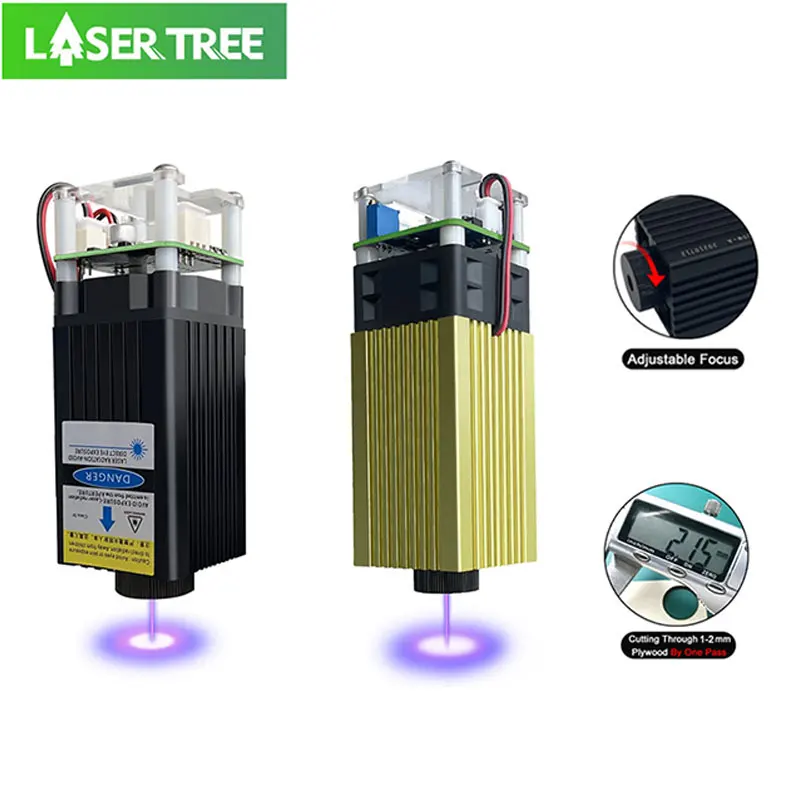
LASER TREE Multi-Wattage Variant Series (4W to 20W)
The LASER TREE multi-tier variant listing (Product ID: 1005003306807390) advertises selectable heads across 4W, 5W, 10W, and 20W tiers for CNC engraving and wood cutting. The listing indicates TTL and PWM control for modulating the 450nm diode output.
Because full technical descriptions and material capability charts are omitted from the listing, prospective buyers should clarify several practical performance and interface questions:
- What actual optical output wattage corresponds to each advertised wattage variant.
- What specific wood species and thicknesses the seller rates each wattage option to cut or engrave.
- What logic-level voltage range the TTL/PWM driver port accepts from host CNC mainboards.
- What pinout configuration is used on the input connector to avoid reverse-polarity damage.
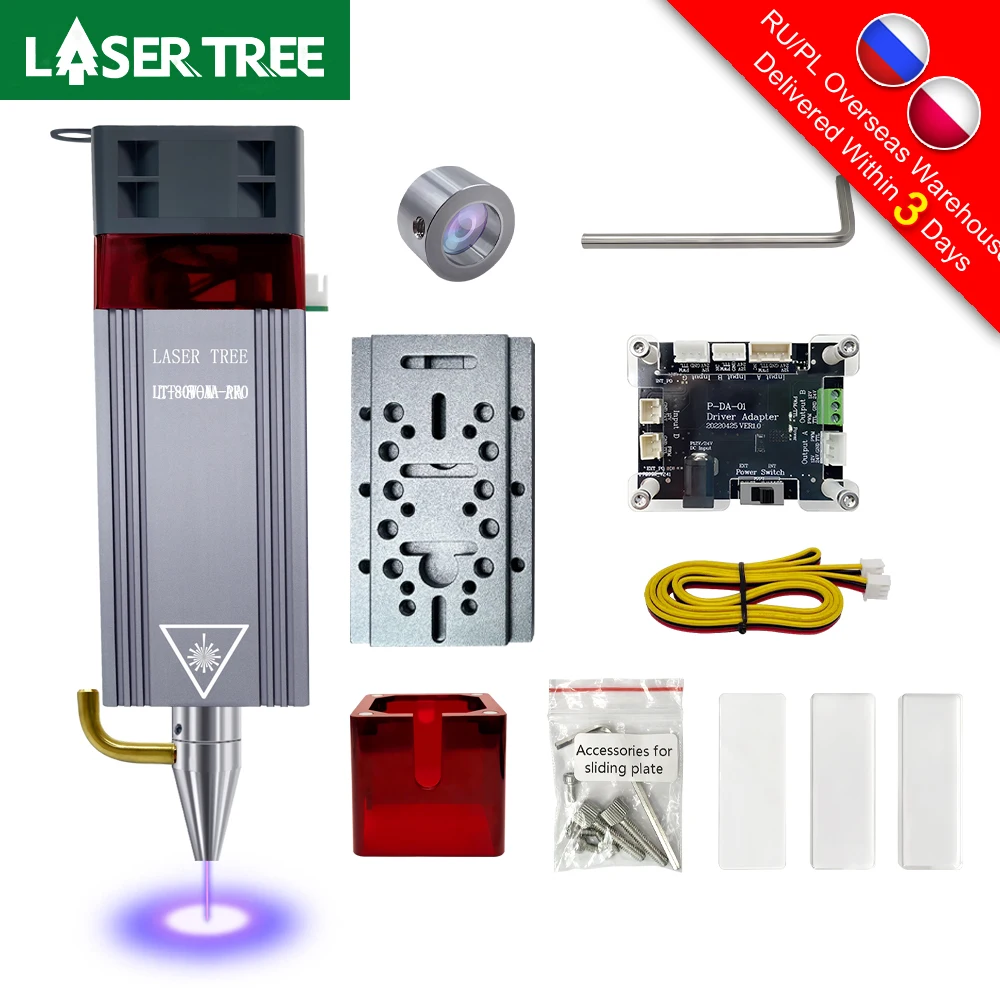
Thermal Management and Optical Maintenance: Air Assist Integration
Operating an open diode on a CNC carriage without positive air pressure exposes the protective lens to rapid soot deposition. Vaporized resins from cutting condense on the optic, absorbing laser energy and risking thermal damage over extended operation.
NEJE 20W Laser Module with Air Assist Kit
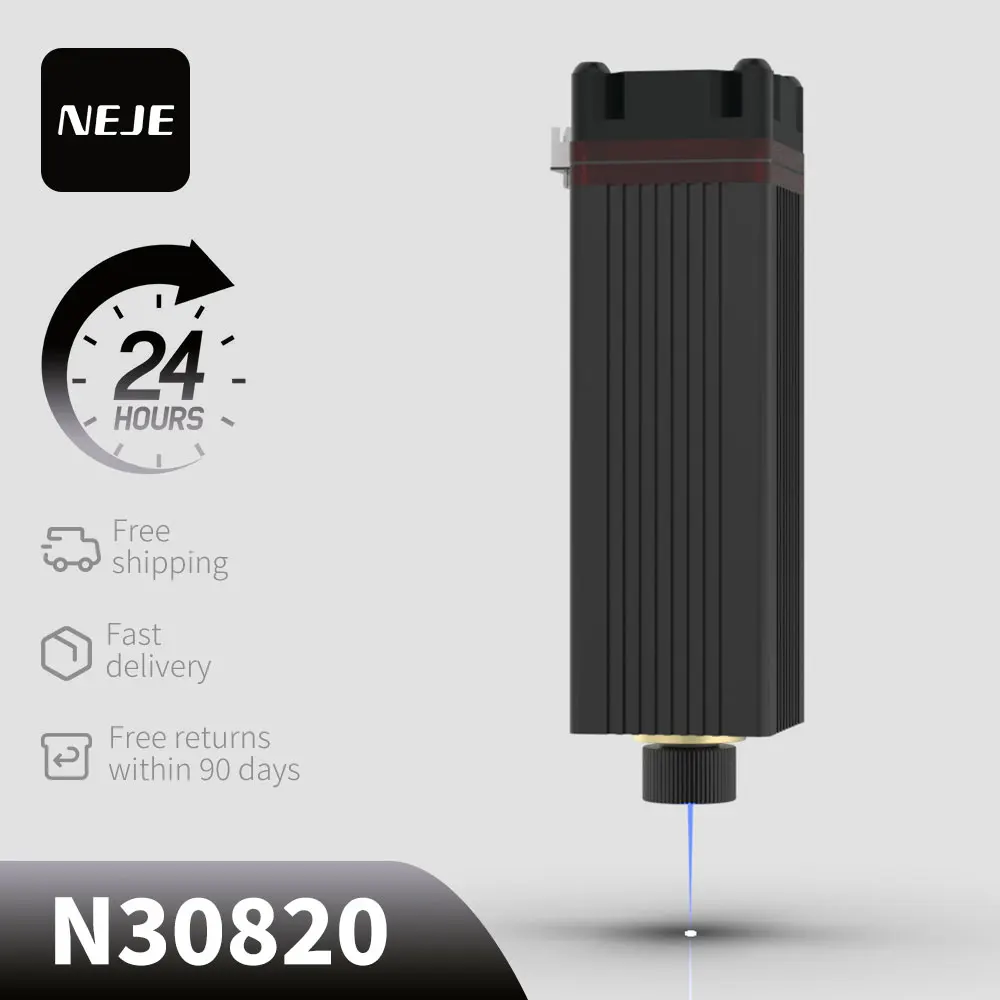
The NEJE 20W laser module (Product ID: 1005009812597639) lists an integrated air assist kit alongside TTL and PWM control for working with wood, glass, stone, and plywood. Adding air assist helps clear smoke from the focal zone and protects the optic from rising debris.
The listing does not provide full component breakdowns or technical documentation, so buyers should confirm the following installation requirements before purchase:
- Whether the kit contains an air compressor and pneumatic tubing, or only the nozzle attachment.
- The true optical power output versus the nominal 20W title claim.
- The recommended air pressure range and fitting sizes for the nozzle inlet.
- The module's required input voltage, operating amperage, and physical mounting dimensions.
Mechanical Height Adjustment: Focal Control
Diode lasers rely on precise focal positioning to achieve their minimum beam waist. On a standard desktop mill, adjusting this distance by jogging the motorized Z-axis lead screw can be slow or constrained by carriage travel limits.
TWO TREES Z-Axis Height Adjuster
The TWO TREES Z-Axis Height Adjuster (Product ID: 1005006522335928) is cataloged as a focus control lifting module for TTS Pro, TTS-55, and TTS-10 laser engravers, allowing manual elevation adjustments of the laser head.
Because the listing lacks dimensioned mechanical drawings and technical specifications, buyers intending to install it on third-party machines should verify:
- The mounting hole patterns and screw sizes on both the gantry side and the module plate.
- The total vertical travel distance (stroke) provided by the lifting mechanism.
- The maximum module weight the adjuster can support without slipping during high-speed moves.
- How much horizontal and vertical clearance the bracket assembly subtracts from the machine's work envelope.

Pre-Purchase Compatibility Checklist
Before purchasing hardware components to convert an existing router frame, review the machine against these physical and electrical constraints:
- Voltage Rail Matching: Confirm the exact operating voltage specified by the manufacturer for the laser module. Connecting an incorrect supply rail will destroy driver circuitry.
- Common Ground Wiring: When using an auxiliary power supply for the laser, bridge its DC negative terminal to the CNC mainboard ground. Without a shared ground reference, logic pulses can float, resulting in erratic firing or failure to switch off.
- Mechanical Clearance: Measure the distance between the gantry rail and the spoilboard. Adding a height adjuster alongside a laser heatsink reduces workpiece clearance; stock thickness must fit comfortably below the focused optical head.
- Enclosure and Eye Safety: Blue diode radiation scatters easily off clamps and work surfaces. Setups require dedicated optical shielding and protective eyewear certified specifically for 450nm laser emissions.